

The biggest commercial carpet cleaning company may not be the right fit for your property. A useful commercial carpet cleaning company comparison looks past brand claims and weighs the work itself: carpet condition, cleaning approach, service scope, and scheduling needs.
Disruption is a practical concern. Staff, tenants, customers, and turnover timelines all affect when carpet washing can happen and how the work should be planned. The right fit depends on whether the project calls for general floor care, attention to heavy stains and soil, or carpet washing coordinated with a wider property cleanout.
This guide covers practical criteria for comparing cleaning approaches and company scope. You’ll see how property use, carpet condition, and access affect the job, what to consider when planning around daily operations, and how to assess fit for an Orange County property. DLJ Property Solutions LLC provides commercial carpet washing and can coordinate it with property cleanouts and focused repairs after trash out, helping prepare a space for its next client.
Key Takeaways
- Start your commercial carpet cleaning company comparison with carpet condition, occupancy, foot traffic, and turnover timing, not company size.
- Compare cleaning methods by moisture considerations, access needs, and likely impact on daily operations.
- Use the same scorecard for each option to assess scope clarity, commercial fit, scheduling, communication, and related property work.
- Plan the work around site access and reopening needs to reduce avoidable disruption.
- Consider how commercial carpet washing can support Orange County property readiness, including projects involving heavy stains, dirt, and wear.
Why a Commercial Carpet Cleaning Company Comparison Starts With Your Property
Choose a service that fits the site, not simply the company with the largest name or the most familiar brand. A useful commercial carpet cleaning company comparison begins with the carpet’s condition, how the space is used, and what needs to happen before, during, and after the work.
An occupied office has different access needs from a vacant commercial unit being prepared for its next tenant. Heavy traffic lanes or visible stains may call for a different scope than general surface soil. Describe the flooring and property schedule, then compare each option against the same requirements.
What makes commercial carpet cleaning different?
Offices, shared spaces, and commercial units see repeated foot traffic from employees, visitors, and customers. Soil can become more visible along entrances and common paths, while ongoing use can leave carpet looking worn. A cleaning plan needs to account for occupancy and the property’s readiness needs, not just the room count. For a broad overview of carpet cleaning methods, review the terminology before comparing service proposals.
Which property details should shape the comparison?
Build a clear picture of the job before weighing company claims. Note the carpeted area, visible stains, traffic lanes, and general condition. Record whether the space is occupied, vacant, or in turnover, and identify access limits or deadlines that affect the work. These details help distinguish an immediate cleaning priority from a longer-term maintenance need.
Keep residential assumptions out of the decision. A home-focused, room-by-room approach may not address shared corridors, work areas, or coordination around staff and tenant access. Assess commercial carpet washing against the building’s use and the result required, whether that means addressing heavy stains, dirt, and wear or preparing flooring for the next occupant.
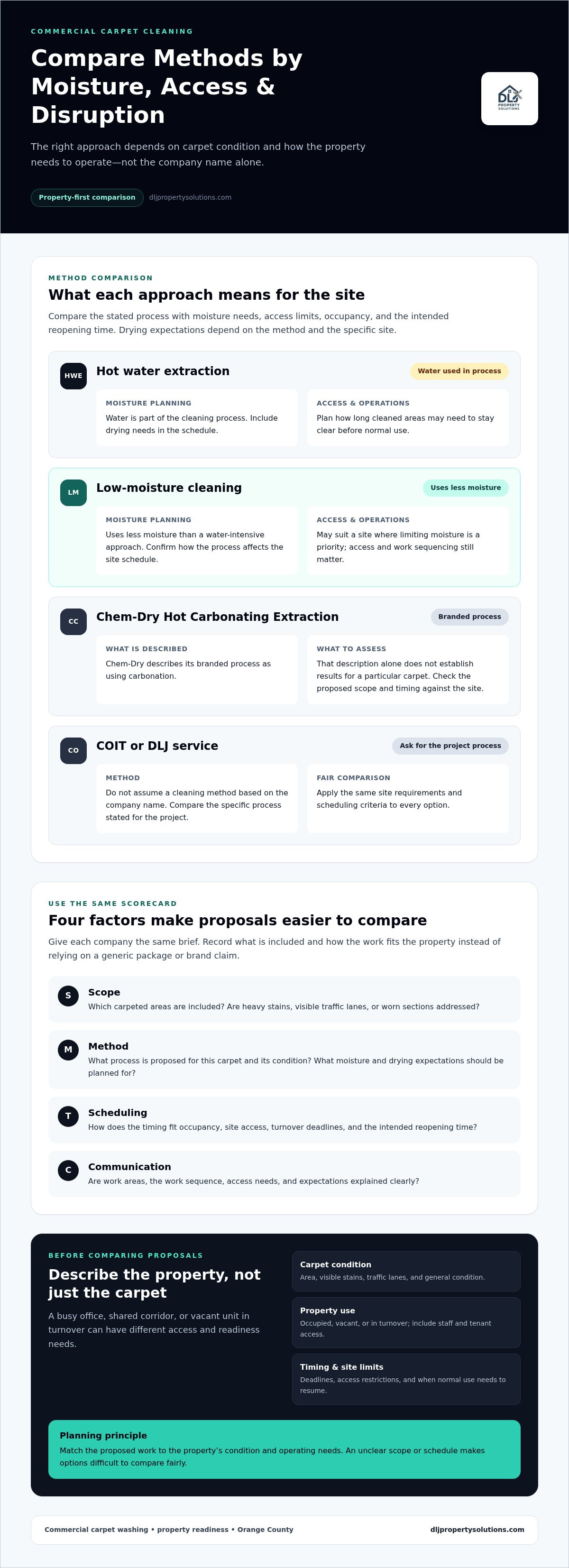
Use four consistent comparison points for every company or service option:
- Scope: Which carpeted areas and visible issues are included?
- Method: What cleaning approach is proposed for the carpet and its condition?
- Scheduling: How does the proposed timing fit occupancy, access, and turnover deadlines?
- Communication: Are the work areas, sequence, and expectations explained clearly?
Apply the same brief across all options. A proposal that sounds impressive but leaves key areas, access needs, or timing unclear is difficult to compare fairly. Look for a scope that reflects the site rather than a generic package. That gives you a practical basis for judging fit and coordinating the work with property readiness, including cleanouts or focused repairs after trash out.
Compare Commercial Carpet Cleaning Methods, Scope, and Work Disruption
Cleaning method affects moisture, access, and how the work fits around an active property. No single approach suits every carpet or schedule. Compare the proposed process with the carpet’s condition and the site’s operating needs, not just a brand’s description of its method.
How should buyers compare cleaning approaches?
Start with the process described in each proposal. Hot water extraction involves applying water as part of cleaning, so access and drying expectations matter to the schedule. Low-moisture approaches use less moisture, but the work plan and expected return to use still depend on the site. Treat these as planning factors, not promises of a specific result.
| Approach or option | Moisture consideration | Access and operational impact |
|---|---|---|
| Hot water extraction | Water is part of the cleaning process; drying needs should be included in the plan. | Consider how long cleaned areas may need to remain clear before normal use. |
| Low-moisture cleaning | Uses less moisture than a water-intensive approach; account for how the process affects the site schedule. | May suit a site where limiting moisture is a priority, but access and work sequencing still matter. |
| Chem-Dry Hot Carbonating Extraction | Chem-Dry describes its branded process as using carbonation. That description alone doesn’t establish results for a particular carpet. | Assess its proposed scope and timing against the property’s occupancy and access needs. |
| COIT or DLJ service | Don’t assume a method based on the company name. Compare the specific process stated for the project. | Use the same site requirements and scheduling criteria applied to every option. |
Drying expectations depend on the method and the specific site. Include the intended reopening time, occupied areas, and any access limits in the comparison. The IICRC standards for carpet cleaning provide an industry reference point, but the practical decision still comes down to the proposed work and the property’s needs.
How does cleaning scope affect the result?
“Clean the carpet” can mean different things. General washing across an area is not the same scope as directing attention to heavy stains, visible traffic lanes, or worn sections. Describe the visible condition and priority areas so each proposal reflects the same work. DLJ provides commercial carpet washing for commercial-grade carpets, including work aimed at heavy stains, dirt, and wear.
For a fair commercial carpet cleaning company comparison, record the areas included, the stated method, site access needs, and schedule assumptions. Keep those details consistent across options. If carpet washing is part of a wider property-readiness project, DLJ commercial carpet washing can fit alongside cleanouts and focused repairs after trash out.
Compare Commercial Carpet Cleaning Companies With a Consistent Scorecard
Use one scorecard for every option. Company history, a branded process, or a strong directory profile can provide context, but none shows by itself whether the work fits your building. Compare the documented scope, commercial setting, timing, communication, and related property work against the same job brief.
Which comparison criteria matter most to a property manager?
Rate each criterion using details available in the company’s service information or project proposal. Focus on whether the stated work addresses the carpet’s observed condition, explains which areas are included, and accounts for access and occupancy. A clear schedule should align with your operating hours or turnover date, rather than rely on a general promise of convenience.
| Option | Scope clarity | Commercial fit | Scheduling and communication | Related property work |
|---|---|---|---|---|
| Chem-Dry | Record the scope stated for this project. | Compare the stated service with the site’s needs. | Use project-specific timing and coordination details. | Note only related work clearly described. |
| COIT | Record the areas and priorities covered. | Check the fit against the commercial setting. | Compare stated access and scheduling details. | Include only relevant work described for the project. |
| Directory listing or local option | Separate listing details from a defined scope. | Look for information relevant to commercial carpet. | Record clear communication and scheduling terms. | Note any directly relevant property services. |
| DLJ Property Solutions LLC | Commercial carpet washing aimed at heavy stains, dirt, and wear. | Commercial-grade carpet washing in Orange County. | Compare project coordination with the site’s schedule. | Cleanouts and focused repairs after trash out. |
Use the table to distinguish documented details from general claims. Don’t assign a high score for polished wording alone. For carpet care context, the Carpet and Rug Institute (CRI) guidelines offer industry information; use them as a reference, not as proof of a company’s performance.
How should brand claims and reviews be weighed?
Company history and branded methods describe the business, not necessarily its fit for your site. Treat them as context. Reviews can add useful detail when they are current, attributable, and about comparable commercial work. Don’t treat directory ratings or unverified comments as evidence of specific results, scheduling reliability, or service quality.
A practical commercial carpet cleaning company comparison separates facts from impressions. Apply the same criteria to Chem-Dry, COIT, directory listings, and local service options. Record what each source actually states, then judge how well the scope and coordination match the property. DLJ’s related cleanout and post-cleanout repair work can fit projects where carpet washing is one part of preparing a space for its next client.
Plan Commercial Carpet Cleaning Around Orange County Operations
Good scheduling starts with the way the property operates. An occupied office, a shared commercial space, and a vacant unit in turnover each have different access and sequencing needs. For Orange County sites, build the plan around the building, its occupants, and the handoff date. Avoid relying on a generic schedule or assumed drying window. The cleaning approach and site conditions shape the work plan.
How can a property team prepare the site?
Map the carpeted areas and mark access points, furniture constraints, visible stains, and sections that must remain in use. Decide how staff or tenants will be notified, which routes should stay open, and who will coordinate access on site. If only part of a building can be cleared at a time, define the order before work begins.
How should cleaning fit a turnover schedule?
Treat carpet washing as one stage in property readiness, not as a standalone date on the calendar. If the space needs a cleanout, focused repairs after trash out, and carpet washing, sequence those tasks so one stage doesn’t obstruct the next. Base reopening decisions on the site and cleaning plan rather than assuming a fixed completion or drying time.
- Review the site. Walk the areas to be cleaned. Record carpeted rooms, entrances, shared paths, stains, furniture limitations, and any areas that can’t be taken out of use.
- Set the work priorities. Identify the main goal, such as addressing visible soil in traffic lanes or preparing a vacant unit for its next occupant. Keep the scope focused on observed carpet condition.
- Coordinate access. Set out how doors, work areas, and equipment routes will be accessed. For occupied properties, share the planned area sequence with staff or tenants so they know which sections will be affected.
- Sequence related work. If a cleanout is part of the project, plan it before carpet washing when that order fits the site. Place focused post-cleanout repairs in the turnover sequence so the property team can coordinate the separate tasks without creating avoidable conflicts.
- Review the cleaning plan. Align the method and scope with the carpet condition, access limits, and schedule. Make sure the plan accounts for occupied areas and the intended handoff without assuming a universal drying window.
- Inspect before reopening. Review the cleaned areas against the agreed scope and the property’s use requirements. Reopen sections according to the site plan and the conditions on the day.
Clear coordination matters in active Orange County offices and commercial units. A staged plan can help keep essential areas available while other sections are addressed. For a vacant property, a defined sequence can connect cleanout, repairs, carpet washing, and turnover without treating them as one undifferentiated task.
For Orange County commercial carpet washing coordinated with property readiness, plan your carpet washing project with DLJ.
Where DLJ Commercial Carpet Washing Fits in a Property Project
DLJ Property Solutions LLC provides commercial carpet washing in Orange County for commercial-grade carpets. The work is aimed at addressing heavy stains, dirt, and wear. For property teams, carpet washing can be a defined part of getting a space ready for continued use or its next client, rather than a separate task disconnected from the rest of the project.
A useful commercial carpet cleaning company comparison considers more than the cleaning itself. It also looks at how the work fits the property’s condition, access needs, and readiness plan. If unwanted items or debris are in the space, a cleanout may need to happen before carpet work can proceed. Clearing the area makes the flooring accessible and keeps the project sequence practical.
When can carpet washing fit a wider property cleanout?
Start by identifying what needs to happen across the space. If items and debris are in the way, plan the cleanout first. Then include carpet washing in the property-readiness sequence, based on the carpet’s condition and the areas that need attention. If focused punch-list repairs follow the cleanout, account for them as a separate stage in preparing the space for its next client.
- Before work: Note which rooms or areas need clearing and which carpeted sections have visible stains, dirt, or wear.
- During planning: Coordinate access and the order of work around occupancy, tenant needs, or a turnover schedule.
- After the cleanout: Plan commercial carpet washing for the accessible carpeted areas, with focused post-cleanout repairs included where needed.
- Before handoff: Review the completed work against the property’s readiness priorities.
This sequence helps property teams treat cleanout, carpet washing, and focused repairs as connected but distinct tasks. It also gives each stage a clear purpose. DLJ handles commercial carpet washing alongside property cleanouts and focused repairs after trash out, supporting a coordinated approach to property readiness without turning the work into a broader renovation project.
What is the next step for an Orange County project?
Share the details that shape the job: property type, carpeted areas, visible condition, and priorities for the space. Include whether it’s occupied or vacant, any access considerations, and whether the work is part of a turnover. These details help frame the scope around the actual project rather than a generic service description.
For commercial carpet washing in Orange County, share your commercial carpet cleaning project details. Include the property condition and readiness priorities so the work can be planned around the site’s needs.
Set the Next Project in Motion
Turn your comparison into a working plan. Before scheduling carpet work, write down the property’s immediate priorities, who needs access, and what must be ready for the next stage of occupancy. That brief gives everyone a clear starting point and keeps decisions tied to the site, not broad company claims.
A commercial carpet cleaning company comparison is most useful when it leads to a defined scope and a workable sequence. DLJ Property Solutions LLC handles commercial carpet washing in Orange County, California, alongside property cleanouts and focused post-cleanout turnover repairs. Share the carpet’s condition, the areas involved, and any occupancy or turnover considerations to move from comparison to planning.
Share your commercial carpet cleaning project details and take the next practical step toward a property-ready space.
Frequently Asked Questions
How do I compare commercial carpet cleaning companies?
Compare each option against the same written brief, then assess commercial fit, stated scope, method transparency, scheduling, communication, and fit with the carpet’s condition. In your commercial carpet cleaning company comparison, separate details you can verify from broad brand claims. For an Orange County property, include occupancy, access constraints, and turnover dates. A large company or one favorable review alone won’t show whether the proposed work fits your site.
Is commercial carpet cleaning different from residential carpet cleaning?
Yes. Business spaces can involve shared corridors, workstations, customer areas, or vacant units, each with different traffic and access patterns. Those conditions shape the cleaning brief and how areas are coordinated. For example, a busy office may need its main route kept usable while work is planned for separate sections. Compare the actual site conditions rather than assuming a residential room-based plan will suit a commercial property.
How much does commercial carpet cleaning cost?
The cost depends on the project scope and site conditions, so a generic price range won’t tell you what a specific job requires. Carpeted area, condition, staining, access, and requested work can affect the project. Compare options using the same defined scope, and keep carpet washing separate from cleanouts or other property work. DLJ tailors commercial carpet washing to the project. Share the property details to discuss the job.
Can commercial carpet cleaning be scheduled around business hours?
Scheduling depends on the property, access, and work plan. Identify busy periods, rooms that need to stay available, and staff or tenant coordination needs before setting the sequence. For example, a team might need a clear route to reception while other areas are addressed separately. Include these constraints in your comparison. Don’t assume every company or cleaning approach uses the same schedule or creates the same access needs.
What should a commercial carpet cleaning comparison include?
Include the property type, carpet condition, areas involved, staining priorities, access requirements, occupancy, scheduling, and communication. Add a column for assumptions or exclusions, such as furniture movement or sections omitted from the proposed scope. That makes gaps easier to spot before choosing a plan. Record each option’s stated method separately from its marketing language, and keep notes tied to the same site brief for a fair comparison.
How often should commercial carpets be cleaned?
There’s no single cleaning schedule for every commercial property. Track recurring soil in entrances, corridors, and shared areas, then review how quickly those spots return after cleaning. Foot traffic, occupancy, carpet condition, and the building’s use all affect timing. Keep routine upkeep decisions separate from a one-time project, such as preparing a vacant unit for turnover. Review the schedule as use changes rather than relying on an arbitrary interval.


