

What if the cleanout is complete, but the property still isn’t ready for its next occupant? A property turnover repair service should connect the cleared space to a defined punch list, not turn a few visible fixes into an open-ended project. After a trash-out, it’s easy to spot loose ends and harder to tell what belongs in scope.
That uncertainty can leave a vacant unit waiting while separate tasks pile up. Define the work around what the property needs now: focused repairs for minor damage, with carpet washing or pressure washing listed separately when they’re part of the turnover.
This guide explains what a turnover repair scope can cover, how to compare service options, and how to prepare clear project details in Orange County. DLJ Property Solutions LLC connects residential and commercial property cleanouts with focused post-cleanout repairs. The goal is straightforward: define the work, handle the right tasks, and prepare the property for its next occupant or owner.
Key Takeaways
- A property turnover repair service focuses on punch-list repairs and minor damage after unwanted items are cleared.
- List cleanout work, remaining repairs, carpet washing, and pressure washing separately to keep the project scope clear.
- Compare service options by the hands-on tasks they cover, their scope boundaries, and the coordination they require.
- Build a practical scope by identifying the property, recording visible needs, listing tasks, and defining the handoff.
- DLJ Property Solutions LLC connects residential and commercial cleanouts in Orange County with focused post-cleanout repairs.
When a Property Turnover Repair Service Helps Get a Unit Ready
A property turnover repair service handles agreed punch-list maintenance and minor damage after a cleanout, helping prepare a property for its next occupant or owner. This is focused work, not a full renovation. The cleanout removes unwanted items; the repair scope addresses the remaining items identified for the project. Readiness depends on the property’s condition and the tasks included in the scope.
What does a turnover repair service cover?
Turnover repairs address specific, visible needs left after a space has been cleared. For example, a punch list might identify minor wall damage or another small maintenance issue. Name the task and its location so everyone can distinguish agreed work from conditions that weren’t included in the list.
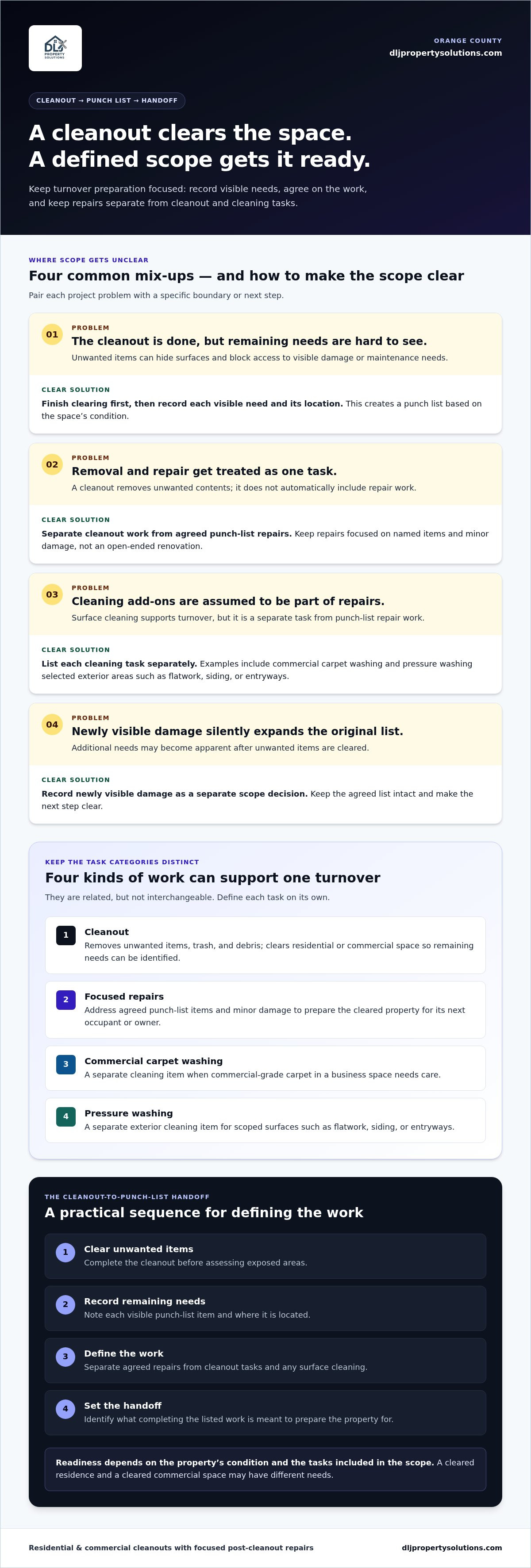
Keep the service boundaries clear. A cleanout removes unwanted contents. Focused repairs address agreed punch-list items and minor damage. Surface cleaning is a separate task, such as commercial carpet washing or pressure washing. These steps can all support turnover preparation, but one does not automatically include the others.
The goal is a usable handoff, not a promise that every property will be ready in the same way. A cleared commercial space may need different attention from a cleared residence. The visible condition, intended next use, and agreed work define what “ready” means for that project.
Why connect repairs to the cleanout handoff?
Unwanted items can hide surfaces and block access. Once the space is clear, remaining damage and maintenance needs are easier to see and record. That creates a practical point to separate completed cleanout tasks from repairs still to be done and any separately scoped cleaning.
The cleanout-to-punch-list handoff is the point where cleared space becomes a defined list of remaining work. A clear handoff reduces confusion about which tasks belong to removal and which belong to repair. It also gives the person overseeing the turnover a concise record of what’s included and what remains outside the agreed scope.
That distinction matters within the wider work of property management, where turnover preparation is one operational responsibility among others. A focused repair scope keeps this stage grounded in the property’s condition rather than expanding into general upkeep or renovation.
Use a simple sequence to keep the handoff usable:
- Clear unwanted items. Complete the cleanout before assessing exposed areas.
- Record remaining needs. Note each visible punch-list item and where it is located.
- Define the work. Separate agreed repairs from cleanout tasks and any surface cleaning.
- Set the handoff. Identify what completing the listed work is meant to prepare the property for.
A bounded list makes it easier to compare the requested work with the property’s actual needs. If additional damage becomes visible after clearing, record it as a separate scope decision instead of silently folding it into the original list. That keeps the work focused and the next step clear.
What a Property Turnover Repair Service Can Include
A clear scope separates four related tasks: removing unwanted items, completing focused repairs, washing commercial carpet, and pressure washing selected exterior surfaces. These tasks can support the same turnover, but they are not interchangeable. Listing each separately helps prevent a repair request from being mistaken for a full cleanout or an open-ended renovation.
Separate cleanout work from turnover repairs
Cleanout work removes unwanted items, trash, and debris from a residential or commercial space. Once the area is clear, focused post-cleanout repairs address the agreed punch-list items and minor damage. The cleanout makes the space accessible; the repair scope identifies what needs attention next.
A property turnover repair service should stay bounded by that list. It is not property management or full-scale renovation. The intended result is practical preparation for the next occupant or owner, based on the property’s condition and the tasks included in the project.
When do cleaning add-ons fit the scope?
Cleaning add-ons fit when they address a specific need at the property. Commercial carpet washing is for commercial-grade carpet in business spaces. Pressure washing can address exterior areas such as flatwork, siding, and entryways. These are separate cleaning tasks, not repair work, so list them as distinct scope items rather than assuming they come with the punch list.
The table shows how to sort the work before it begins:
| Task category | Purpose | Place in turnover preparation |
|---|---|---|
| Cleanout | Remove unwanted items, trash, and debris. | Clears residential or commercial space so remaining needs can be identified. |
| Focused repairs | Address agreed punch-list items and minor damage. | Prepares the cleared property for its next occupant or owner. |
| Commercial carpet washing | Wash commercial-grade carpet in a business space. | A separate cleaning item when carpet care is part of the project. |
| Pressure washing add-on | Wash scoped exterior surfaces, such as flatwork, siding, or entryways. | A separate exterior cleaning item when relevant to the property. |
Keep the list specific. Identify the area, name the task, and distinguish repair work from cleaning. If a commercial unit needs a punch-list repair and carpet washing, record them as separate items. If an exterior entryway also needs pressure washing, list that as its own add-on. This makes the scope easier to review and ties each task to an actual property need.
For a project that combines clearing a space with focused repairs, review the work with DLJ Property Solutions. A defined list gives the turnover a practical starting point.
Compare Turnover Repair Services by Scope, Not by Service Labels
Service labels can hide important differences. Compare what gets done by hand, where the work stops, and how much coordination the property needs. A focused punch-list service, a broader turnover package, and maintenance software solve different parts of the turnover process. The right fit depends on the property’s condition and the work required, not on which label sounds most complete.
| Option | Hands-on tasks | Scope boundaries | Coordination needs | Best fit |
|---|---|---|---|---|
| Focused turnover repairs | Cleanout and agreed punch-list repairs for minor damage. | Limited to listed post-cleanout tasks; not a full renovation. | A clear task list and handoff between clearing and repair. | A cleared property with specific remaining work. |
| Broad turnover package | May combine several turnover tasks under one broader scope. | Can cover more categories than a focused repair list. | Requires coordination across the tasks included in the package. | A property whose needs extend beyond a short punch list. |
| Software-led maintenance coordination | Organizes requests, communication, and scheduling; software itself does not perform repairs. | Supports workflow rather than defining or completing physical work. | People still need to act on the information and arrange the work. | Teams that need a tool to organize maintenance activity. |
Focused punch-list repairs or a full renovation?
A focused service suits a property that needs defined maintenance and minor-damage work after a cleanout. Full-scale remodeling addresses a broader set of changes. Neither scope is universally better. Match the work to the property: a short list of specific repairs points toward punch-list service, while extensive changes call for a broader project scope. A property turnover repair service should not be treated as a substitute for renovation.
Punch-list turnover repairs address specific needs after a cleanout; remodeling changes the property on a broader scale. That distinction keeps expectations clear. Define the tasks before work starts, and don’t use a repair label to imply that major upgrades are included.
Hands-on service or coordination software?
Software can help organize maintenance communication and scheduling, but it does not clear a property or complete repairs. Those are hands-on tasks. DLJ Property Solutions LLC provides residential and commercial cleanouts, followed by focused post-cleanout punch-list repairs. The work and the coordination tool serve different functions, and a property may need one, the other, or both depending on how its turnover is managed.
Use the comparison to identify the actual gap. If the space still contains unwanted items, coordination alone won’t clear it. If the property is cleared and only defined minor repairs remain, a focused scope may fit. If the work goes beyond those needs, define a broader project scope rather than stretching the punch list. Clear boundaries make it easier to compare options and avoid treating software, repair work, and renovation as interchangeable.
Build a Clear Property Turnover Repair Scope Before Work Starts
A useful scope gives everyone the same working picture: which property is involved, what remains after the cleanout, which tasks are included, and what the completed work should prepare the space for. Keep it factual. Describe visible needs and locations rather than guessing at causes or adding work that hasn’t been agreed.
Document the property condition and remaining work
Start with the property type and the areas involved. Then separate what’s already been completed from what still needs attention. Photos and a written list make the requested work easier to understand, especially when several rooms or exterior areas are involved. Tie each item to a clear location.
- Identify the property. Note whether it’s residential or commercial, and name the unit, suite, or other location used to distinguish it from other projects.
- Record visible needs. List punch-list items by room or area. Use plain descriptions, such as “minor wall damage in the rear office,” rather than a broad entry like “repair interior.” Add a photo when it helps show the location or visible condition.
- Separate completed and remaining work. Mark cleanout tasks as complete only when unwanted items and debris have been removed. Keep remaining repairs on a separate list. This prevents a completed trash-out from being mistaken for a finished turnover.
- Define each requested task. State which listed repairs are part of the project. Keep unrelated or newly noticed work outside the scope until it’s clearly added.
Set the handoff and add-on requirements
Next, say what the property is being prepared for: an inspection, a turnover, or a new occupant. That endpoint helps keep the task list relevant without assuming every property needs the same work. A property turnover repair service is easier to scope when the intended handoff is clear.
- List cleaning separately. If commercial carpet washing is needed, identify the business area with carpet and include it as its own task. Don’t treat it as part of the repair list.
- Note exterior washing only when relevant. If pressure washing is part of the project, specify the exterior area, such as flatwork, siding, or an entryway. Leave it off the scope when it isn’t needed.
- Confirm the boundaries in writing. Group work into completed cleanout tasks, remaining repairs, and any separate cleaning add-ons. This gives the person overseeing the turnover a clear record of what’s included and what is not.
Before work starts, review the list against the property’s current condition. A clear scope helps keep a small punch list from becoming an undefined project. DLJ Property Solutions LLC handles Orange County cleanouts and focused post-cleanout repairs. Share your property and scope details to outline the work.
Choose DLJ for Property Turnover Repairs in Orange County
DLJ Property Solutions LLC serves Orange County with residential and commercial cleanouts, followed by focused post-cleanout punch-list repairs. The sequence is practical: clear unwanted contents, identify the remaining work, then address agreed minor damage and maintenance needs. Each step has a defined place in preparing a property for its next occupant or owner.
How DLJ supports turnover preparation
A cleanout removes unwanted items, trash, and debris from a property. Once the space is clear, the remaining punch-list work can be identified and scoped. DLJ’s post-cleanout repairs focus on that defined list and minor damage. This is hands-on turnover preparation, not property management or full-scale remodeling.
Keeping the work connected creates a clear handoff. The cleanout addresses what needs to be removed; the repair scope addresses what remains after the space is clear. DLJ also provides commercial carpet washing and pressure washing as add-ons. They are separate tasks, not automatic parts of every repair scope.
The distinction keeps the requested work grounded in the property’s actual condition. A residential cleanout may leave a different punch list from a commercial one. The scope should reflect visible needs and agreed tasks, rather than assume every property requires the same package.
Share the details for an Orange County project
Useful project details make it easier to define the turnover scope. Include:
- Property type and location: State whether the space is residential or commercial and where in Orange County it’s located.
- Cleanout status: Note whether unwanted items and debris have been cleared or whether cleanout work is still needed.
- Known repair needs: Describe visible punch-list items and minor damage, including the area involved.
- Cleaning add-ons: Identify commercial carpet washing or pressure washing if the project calls for it, and name the areas involved.
- Next use: Explain whether the property is being prepared for an inspection, turnover, or a new occupant or owner.
This gives the project a clear starting point. A concise list or photos can show which tasks remain and which work is complete. Keep repair needs separate from cleaning add-ons so the scope stays easy to review.
If you need a property turnover repair service in Orange County, share your property type, location, cleanout status, and known needs with DLJ Property Solutions. Include any relevant carpet washing or pressure washing requests.
Set the Next Turnover Step in Motion
A vacant property needs a defined next step, not a growing list of assumptions. Use the scope you’ve built to keep decisions tied to the property’s current condition and intended handoff. If a new need appears, record it as a separate item before adding it to the work. That gives everyone a shared reference point.
The right property turnover repair service is the one that fits the actual work. Bring together the property type, location, cleanout status, and visible needs. Note any separate cleaning requests, too. Clear details give the project a practical starting point.
DLJ Property Solutions LLC serves Orange County properties with cleanouts, focused repairs, commercial carpet washing, and pressure washing add-ons. Share your Orange County property details with DLJ to outline the work you need and get started.
Frequently Asked Questions
What is a property turnover repair service?
A property turnover repair service is focused repair work that helps prepare a property for its next occupant or owner. In Orange County, DLJ Property Solutions LLC performs repairs after a cleanout, addressing identified punch-list maintenance and minor damage. The scope depends on the property’s condition and requested tasks. A defined list of remaining items, for example, is a better fit for this service than a request to overhaul the entire space.
Can cleanout and turnover repairs be handled as connected work?
Yes. DLJ handles property cleanouts and post-cleanout turnover repairs as connected steps. The cleanout clears unwanted contents; the repair scope addresses remaining listed needs. Share whether the property is residential or commercial, where it’s located in Orange County, and what work remains. If carpet washing or pressure washing is also needed, list it separately as an add-on rather than treating it as part of the repairs.
Does a property turnover repair service include remodeling?
No. Focused turnover repairs address a defined punch list and minor damage, while remodeling covers a broader project scope. The distinction matters when the property needs extensive changes rather than a limited set of post-cleanout tasks. Describe the property’s condition and the specific work required for its next use to keep the requested scope clear.
How long do property turnover repairs take?
Timing depends on the property’s condition, the tasks identified, and how much work remains after the cleanout. A short list in one area differs from a scope covering several parts of a property. Share the known tasks and note whether the cleanout is complete to give the project a practical starting point. A generic timeline can’t account for those project-specific details.
What information should I provide when requesting a turnover repair project?
Share the Orange County property location, whether it’s residential or commercial, and the cleanout status. Then describe visible repair needs by area. Photos can help show where an item is located and what remains. If the project also needs commercial carpet washing or pressure washing, name the relevant areas separately. These details tie the requested scope to the property and its next use.
Can turnover services include commercial carpet washing or pressure washing?
Yes. DLJ offers commercial carpet washing and pressure washing as add-ons for relevant projects. Carpet washing is for commercial-grade carpets in business spaces. Pressure washing can address exterior surfaces such as flatwork, siding, and entryways. These are separate scope items, not automatic parts of every repair project. Name the areas involved when outlining an Orange County property project.


