

A turnover rarely gets delayed by one obvious repair. It’s the loose handle, missed wall damage, or cleaning scheduled before dusty repair work that creates another trip through the unit. A clear plan for rental turnover punch list repairs turns each observed issue into a specific, prioritized task.
It’s easy to miss a small defect during a rushed walk-through or be unsure what needs attention before the next tenancy. Use a repeatable inspection and documentation process: record what you find, separate safety and functional concerns from cosmetic work, and set the work order before tasks begin.
This guide explains how to build a practical punch list, document the move-out condition, and sequence cleanout, repairs, and cleaning. A completed cleanout creates a clear starting point for focused turnover repairs. DLJ Property Solutions LLC handles residential and commercial property cleanouts and post-cleanout punch-list repairs in Orange County, California. Commercial carpet washing and pressure washing are available as add-ons when they fit the handoff. The goal is to move from a documented move-out condition to a space ready for its next occupant.
Key Takeaways
- Build rental turnover punch list repairs around specific observations, not broad notes. Clear descriptions make tasks easier to assign and track.
- Group defects by room and system so doors, walls, plumbing fixtures, flooring, and lighting get a consistent review.
- Prioritize safety and functional concerns, then damage prevention, before appearance-focused touch-ups.
- Use a numbered workflow to move from walkthrough photos to repair assignments and a final readiness review.
- Connect cleanout completion with focused punch-list repairs, keeping the work scoped to maintenance and minor damage.
What Are Rental Turnover Punch List Repairs?
A move-out inspection can uncover a loose cabinet pull, a leaking fixture, damaged drywall, and a flooring issue in the same unit. Each condition deserves a clear record, but not every task has the same urgency or belongs in the same work category. Without specific notes, small repairs can be overlooked or confused with cleanout and cleaning tasks.
A rental turnover punch list is a documented set of specific repairs identified during an inspection and assigned for completion before the next occupancy. Each entry should state what is visibly wrong and where it is located. That makes the list a working scope, not a general instruction to “fix the unit.” Rental turnover punch list repairs are easier to track when every item can be assigned and checked off separately.
The wider field of Property management encompasses maintenance and repairs, but a turnover punch list has a narrower job: identify discrete repair work between the observed condition and the next-ready handoff. It doesn’t replace a full property assessment or determine who is responsible for a defect.
What belongs on a rental turnover repair list?
Include visible, specific conditions that call for repair. Record the room or exact location, then describe the issue without guessing at its cause or assigning responsibility. For example, “bathroom sink faucet drips when turned off” is more useful than “plumbing problem.” Keep each item separate so it can be assigned and verified on its own.
- Doors and hardware: Loose hinges, a sticking door, or a handle that moves when used.
- Walls and ceilings: A visible drywall hole, a cracked patch, or peeling paint at a specific spot.
- Plumbing fixtures: A dripping faucet, a loose toilet handle, or a visible leak beneath a sink.
- Flooring: A lifted edge, a cracked tile, or a damaged section of carpet.
- Lighting: A fixture that doesn’t turn on or a visibly damaged switch plate.
Use room names consistently, such as “north bedroom” or “hall bathroom.” Add a photo when it helps show the location or condition. The goal is a clear work instruction, not a conclusion about how the issue happened.
What is outside a focused punch-list scope?
Separate repair work from other turnover tasks. Removing abandoned belongings, trash, and debris is cleanout work. Wiping surfaces and washing carpet are cleaning tasks. They may happen during the same turnover, but they need their own scope and completion check. Keeping the categories distinct helps prevent a repair item from disappearing inside a broad “clean and make ready” instruction.
A list of minor repairs is also different from a full remodel. Replacing a loose door handle or patching a small drywall area is focused maintenance. Reworking a room or changing its layout is a larger project, not a punch-list repair. DLJ Property Solutions LLC connects property cleanouts with post-cleanout repairs for punch-list maintenance and minor damage. Commercial carpet washing and pressure washing are separate add-ons when they fit the property handoff.
Which Rental Turnover Repairs Should Go on the Punch List?
Record conditions that may need repair, but don’t treat every mark or worn surface as an automatic work order. Consider the visible condition, how the item functions, and the agreed turnover scope. A wall scuff may be an appearance item. A door that won’t latch or a light that won’t turn on needs functional follow-up. Keep those categories distinct so the list supports decisions instead of assuming them.
Room-by-room checks for visible damage
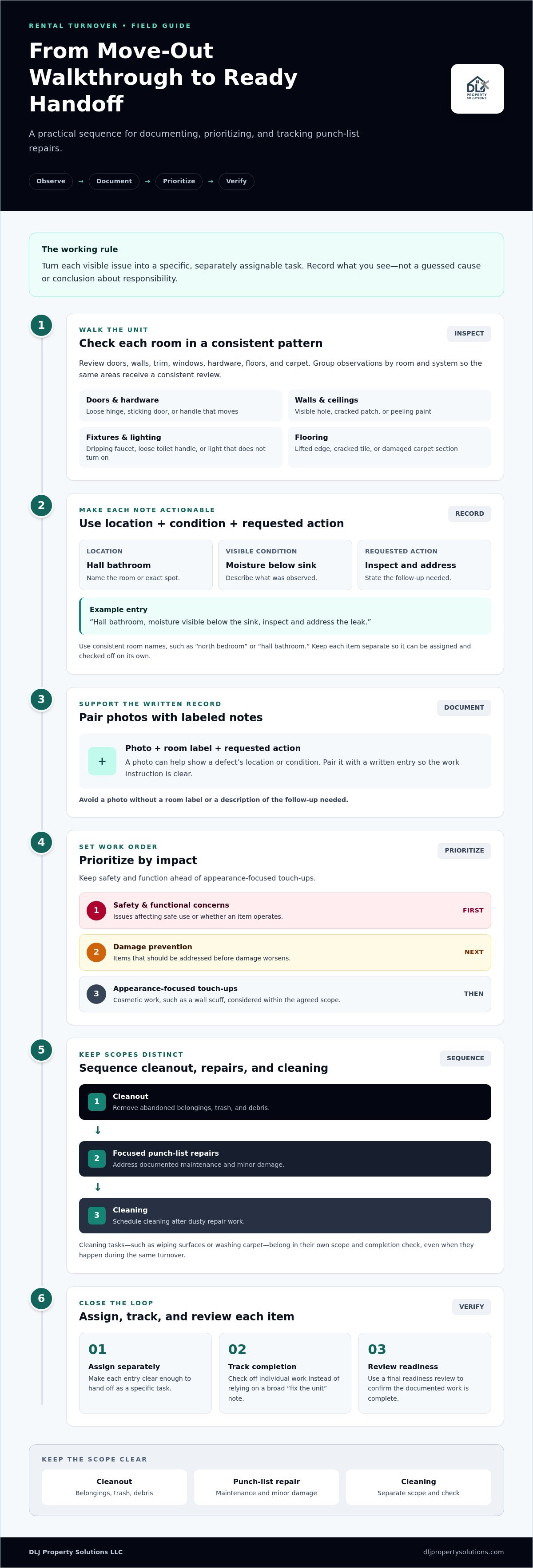
Move through each room in a consistent pattern. Check walls, doors, trim, windows, hardware, floors, and carpet. Write the room name and exact location, then describe what you can see. “Living room, carpet seam lifted beside the patio door” gives a clearer work instruction than “check carpet.”
- Entry and interior doors: Note a loose hinge, damaged edge, or latch that doesn’t catch.
- Walls and trim: Record a visible hole, chipped trim, or peeling paint, with the wall or corner identified.
- Windows and hardware: Describe a cracked pane, loose lock, or window that sticks during operation.
- Floors and carpet: Mark a torn section, stained area, lifted edge, or cracked tile by room and position.
Photos can help locate a defect, but pair each image with a written entry. A picture without a room label or requested action may still leave the person doing the work guessing.
Functional items to record for follow-up
Check fixtures and visible system operation without trying to identify hidden causes. Describe what happened during the inspection: a faucet continued dripping after use, a ceiling light didn’t switch on, or a vent made an unusual sound. These observations flag issues for follow-up. They don’t diagnose plumbing, electrical, or HVAC faults.
- Plumbing fixtures: State where moisture or dripping appeared and when it was observed.
- Lights and switches: Identify the fixture or switch and record whether it operated.
- Other visible operation: Note the system, room, and specific unusual behavior without naming a cause.
Use a simple entry format: location, visible condition, requested action. For example, “Hall bathroom, moisture visible below the sink, inspect and address the leak.” This keeps the request factual and gives the repair assignment a clear starting point. Mark appearance-only touch-ups separately from items that affect normal use or show active moisture. The distinction supports prioritization without making assumptions about responsibility or required work.
Keep cleaning and repairs as separate assignments. Commercial carpet washing or pressure washing may fit the turnover, but neither is a repair item. For a handoff that needs debris removal followed by focused minor-damage work, property cleanout and turnover repair work can connect those separate tasks.
How to Prioritize Rental Turnover Punch List Repairs
A punch list can contain a dripping faucet, a damaged floor edge, and a paint scuff. Treating all three as equal makes scheduling harder. Give each item a priority based on what it affects: safety or normal function, risk of further damage, or appearance alone. Address risk and function before appearance. That rule sets a useful order without imposing a universal deadline or assuming every visible condition needs repair.
Separate urgent, functional, and cosmetic work
Start by flagging visible conditions that may pose a safety concern or involve active damage. A leak under a sink generally deserves earlier attention than a paint scuff because moisture may continue to affect the surrounding area. Assess an unsafe visible condition before cosmetic work proceeds.
Next, group items that affect normal use, such as a light that won’t operate or a door that doesn’t latch. Keep appearance-only corrections in a separate group. Cosmetic work can rank lower only when it doesn’t hide moisture, damage, or a functional problem. If a mark’s significance is unclear, record what you see and leave the priority open for assessment rather than guessing.
Batch tasks without losing track of scope
Once priorities are set, group similar work by room or trade to make assignments easier. Keep every repair as its own documented item, even when several tasks go to the same worker. A room-level group helps with coordination, but it doesn’t replace a clear scope for each task.
Sequence work to avoid redoing finished surfaces. For example, complete a repair that may disturb drywall before scheduling paint touch-ups in that area. If removing a loose floor edge exposes an unknown condition, pause that item for assessment. Don’t assume the visible defect shows the full extent of the work.
This approach makes rental turnover punch list repairs easier to schedule and review: assess risk first, prevent further damage, restore function, then handle appearance items that fit the agreed scope.
How to Build and Track an Orange County Turnover Punch List
A useful punch list connects the move-out walkthrough to the completed handoff. Each observation needs a location, a clear task, a priority, and a status. Precise notes reduce missed repairs, duplicate assignments, and confusion about what remains open.
Use one shared record for the property, whether it’s a spreadsheet or another tracking format. Keep the same fields for every item. In Orange County, DLJ Property Solutions LLC supports property cleanouts and focused post-cleanout turnover repairs for residential and commercial properties. A consistent record helps create a clear handoff from cleared work areas to repair assignments and final review.
- Walk through every room. Inspect the property systematically, using the same route each time. Note the room and exact location for each condition. Don’t rely on memory or broad entries such as “repair bedroom.”
- Take useful photos. Use a wider view to show where an item is, then a close-up when detail matters. Make sure each image can be matched to a specific punch-list entry. Photos support the written record; they don’t replace it.
- Write the observation and requested action. Describe what you saw, not what you assume caused it. Record the room, visible condition, requested task, priority, assigned person or crew, and current status. Use consistent status labels such as open, assigned, and completed.
- Set priority and assign the work. Use the risk and function categories from the inspection to determine what needs earlier attention. Assign each task clearly, even when several items are grouped for the same crew. Keep individual entries so each repair can be checked off separately.
- Update the record as work progresses. Move an item from open to assigned when it has an owner, then mark it completed only after the work is finished and reviewed. If an inspection or repair reveals a different condition, add a new entry rather than silently changing the original observation.
- Review the property against the list. Walk the unit again and compare each completed item with its original note and photo. Confirm what is complete, flag anything still open, and keep separate cleaning tasks visible in the handoff record.
Sequence the handoff between cleanout and repairs
Start repair scoping once unwanted items and debris have been cleared from the work areas. A cleanout creates room to see surfaces and reach locations where repair tasks are needed. Complete repair work before final surface cleaning when both affect the same area. Dust or debris from a repair can make cleaning done too early ineffective. Keep cleaning as a separate task, then use the final walkthrough to verify the original punch-list items one by one.
For Orange County turnovers that need a cleanout followed by focused maintenance and minor-damage repairs, property cleanout and turnover repair support connects the work in sequence.
How DLJ Property Solutions Supports Rental Turnover Repairs
A clear punch list links the condition found at move-out to the work needed before the next occupant. It also separates cleanout, repair, and cleaning tasks, so each part of the handoff has a defined scope. DLJ Property Solutions LLC provides property cleanouts and focused post-cleanout repairs for residential and commercial properties in Orange County. The repair work covers punch-list maintenance and minor damage, not remodeling.
Coordinate cleanout and repair work
Unwanted belongings, trash, and debris can block access to walls, floors, fixtures, and other repair areas. Completing the cleanout first creates a clearer starting point for scoping rental turnover punch list repairs. Once areas are accessible, the documented list can guide work item by item, with locations and requested tasks easy to identify.
Keep the work categories distinct. Cleanout removes unwanted items and debris. Repairs address listed maintenance or minor damage. Cleaning handles surfaces after repair work where needed. This separation keeps assignments clear, especially when several tasks affect the same room.
- Cleanout: Identify the areas where belongings, trash, or debris need to be cleared.
- Repair: Share the punch-list items and their locations, such as a damaged wall area or loose hardware.
- Surface cleaning: Note any relevant commercial carpet washing or pressure washing as a separate add-on task.
Keep the work scope practical. A task-by-task list makes it easier to distinguish focused turnover repairs from a broader project. If clearing an area reveals another visible condition, add it as a separate item for review rather than folding it into an unrelated repair request.
Set up the next turnover step
Before arranging the work, pull together three basics: the property type, the rooms or areas involved, and the repair conditions observed. Include existing photos or notes if available. Specific details help establish what needs to be cleared, which repairs are on the list, and whether a surface-cleaning add-on fits the handoff.
For example, “commercial unit, rear office, damaged drywall beside the doorway” gives a more useful starting point than “touch up office.” Separate known repair items from conditions that still need assessment. That keeps the scope grounded in what’s visible and helps prevent assumptions about hidden causes or extra work.
DLJ Property Solutions LLC connects Orange County property cleanouts with focused post-cleanout repairs, providing a practical next step from cleared space to repair handoff. Share the property type, affected rooms, and observed items to outline the work.
Share your Orange County turnover project details
Set Up the Next Turnover With a Clear Scope
Make the punch list the starting point for the next handoff, not a document that gets filed away after the inspection. Keep it with the property’s turnover records and update it when work is assigned or completed. That gives the next inspection a useful reference and keeps rental turnover punch list repairs connected to the conditions actually observed.
For owners with a unit to clear and prepare, DLJ Property Solutions serves Orange County, California, combining property cleanouts with focused post-cleanout turnover repairs. Share the property type, areas involved, and work identified. A concise project outline makes it easier to define the next step.
Share your Orange County turnover project details. Start with what needs attention, then move forward with a clear handoff plan.
Frequently Asked Questions
What is included in a rental turnover punch list?
A rental turnover punch list includes specific repair tasks identified during a property inspection. It can cover items such as a loose cabinet hinge, a door that sticks, or a damaged section of flooring. For rental turnover punch list repairs, make each entry clear enough to guide the work and verify completion. Keep unrelated tasks, such as removing abandoned items or washing carpet, in separate categories.
When should a landlord start a turnover punch list?
Start planning as soon as you know the unit will turn over, then inspect and update the list once the space is accessible. An early draft helps identify potential work and organize access. A final walkthrough after belongings are removed can reveal conditions previously blocked by furniture or stored items. Keep the draft distinct from confirmed repair tasks until the property can be inspected properly.
How should I document rental turnover repairs?
Use one record for all repair items, with a consistent entry for each task. Include the room, exact location, visible condition, requested action, assigned status, and completion status. Label photos so they match the relevant entry. For example, note whether an image shows the whole wall or a close view of a damaged section. This makes it easier to compare the completed work with the original observation.
How do I separate normal wear from damage that needs repair?
Describe the condition before deciding what category it belongs in. A faint mark on a wall and a large hole are different observable conditions, but the punch list should record what is present rather than assign blame. Compare the current condition with available move-in records and photos. Keep repair decisions and any responsibility or deposit questions separate, since a maintenance list alone doesn’t establish who caused an issue.
Should repairs happen before carpet cleaning during a rental turnover?
Complete repairs before carpet cleaning when the work could create dust, debris, or foot traffic in the same area. For example, patching a nearby wall after carpet washing could leave residue on the finished carpet. Plan tasks around the work involved and the rooms affected. Commercial carpet washing can be scheduled as a separate cleaning task after repair work in the relevant space is finished.
Can a rental turnover punch list include commercial properties in Orange County?
Yes. A turnover punch list can track repair work in a commercial space as well as a residential rental. Record the affected area by its practical use, such as reception, office, or staff washroom, and describe how the observed condition affects that space. DLJ Property Solutions serves residential and commercial properties in Orange County with cleanouts and focused post-cleanout turnover repairs.
When should a punch-list repair be treated as a larger project instead?
Treat the work as a larger project when the observed issue extends beyond a discrete maintenance task or minor damage. Several connected repairs, a problem affecting multiple areas, or work that changes a room’s layout may need a broader scope than a punch list can describe. Record the visible conditions and locations first. DLJ Property Solutions handles focused post-cleanout repairs, not full remodeling or renovation.


