

What if the fastest way to make a carpet stain worse is to scrub it? In a busy workplace, a fresh spill needs prompt attention, but the wrong cleaner or too much force can spread it or push it deeper into the fibers. Effective commercial carpet stain removal starts with control: identify what spilled, blot carefully, and avoid adding products at random.
This guide walks through a practical response to common stains, from the first blot to deciding when to stop. You’ll learn how to handle a fresh spill, which mistakes to avoid, and when spot treatment has reached its limit. If a stain is set in, returns after drying, or appears alongside broader dirt and wear, commercial carpet washing may be the more practical next step. Start by assessing the stain, use a measured approach, and stop before repeated treatment causes more trouble.
Key Takeaways
- Identify the spill before choosing a treatment so your first response is targeted and controlled.
- Follow a careful sequence for fresh spills, working from the stain’s outer edge toward the center.
- Avoid scrubbing, excess water, and untested cleaners, which can spread stains or affect carpet fibers.
- Know when to stop DIY commercial carpet stain removal, especially if the spill is unknown, the stain returns, or fibers show damage.
- Recognize when widespread soil or stubborn stains call for commercial carpet washing in Orange County.
Commercial Carpet Stain Removal Starts with Identifying the Spill
Commercial carpet stain removal means treating a specific mark without cleaning the entire carpet. Before reaching for a cleaner, work out what spilled, where it landed, and what the carpet can tolerate. This quick assessment helps you choose a measured response and lowers the risk of spreading the mark or damaging the carpet.
Start with what you can observe. A fresh liquid spill may still be near the carpet surface, while a dried stain may have bonded more firmly to the fibers. An oily mark can behave differently from a colored beverage spill. Food, ink, and other substances can leave different residues. Appearance offers clues, but it cannot always identify a spill with certainty.
Identify the stain before choosing a product. The wrong first treatment can make a manageable mark harder to address. No method guarantees complete removal. Carpet material, backing, and earlier cleaning attempts can all affect the result, so take those factors into account before treating the spot.
What to check before treating a commercial carpet stain
Take a moment to record what you know. A short, accurate account can reduce guesswork, especially if the stain needs more than spot treatment.
- Spill: Note what caused it, if known, and whether it was food, a drink, ink, oil, or another substance.
- Time and condition: Estimate when it happened and check whether the stain is wet, partly dried, or fully dry.
- Size and location: Note the affected area and whether the spill reached a seam, edge, or high-traffic area.
- Carpet guidance: Check available care instructions and fiber information before applying a cleaner.
- Earlier attempts: Find out what was already applied and how the area was treated. Residue from a previous product can affect the next step.
If the spill is unknown, don’t test several cleaners to see what works. Uncertainty is a reason to pause, not to combine products or increase the amount used.
How stain type and carpet fiber affect the approach
Food may leave solid material as well as colored residue. A beverage can spread beyond the area that first looks wet. Ink may leave a concentrated mark, while an oily spill can cling differently from a water-based one. These examples help describe the problem, but they are not fixed cleaning recipes. A product that suits one stain may not suit another.
Fiber matters, too. Nylon, polyester, and wool can respond differently to cleaning products and treatment. The carpet’s backing also affects how moisture moves through the material. A cleaner that appears suitable on the surface may still be a poor fit for the carpet’s full construction. Check care guidance where available, and test any proposed spot treatment in an inconspicuous area before using it on the stain.
Carpet cleaning includes different methods for different needs. The Carpet Cleaning Methods overview describes approaches such as hot water extraction and dry cleaning. The practical takeaway is to identify the spill and carpet first, then choose a measured response. Don’t assume one cleaner or method works for every commercial carpet.
How to Remove a Fresh Commercial Carpet Stain Step by Step
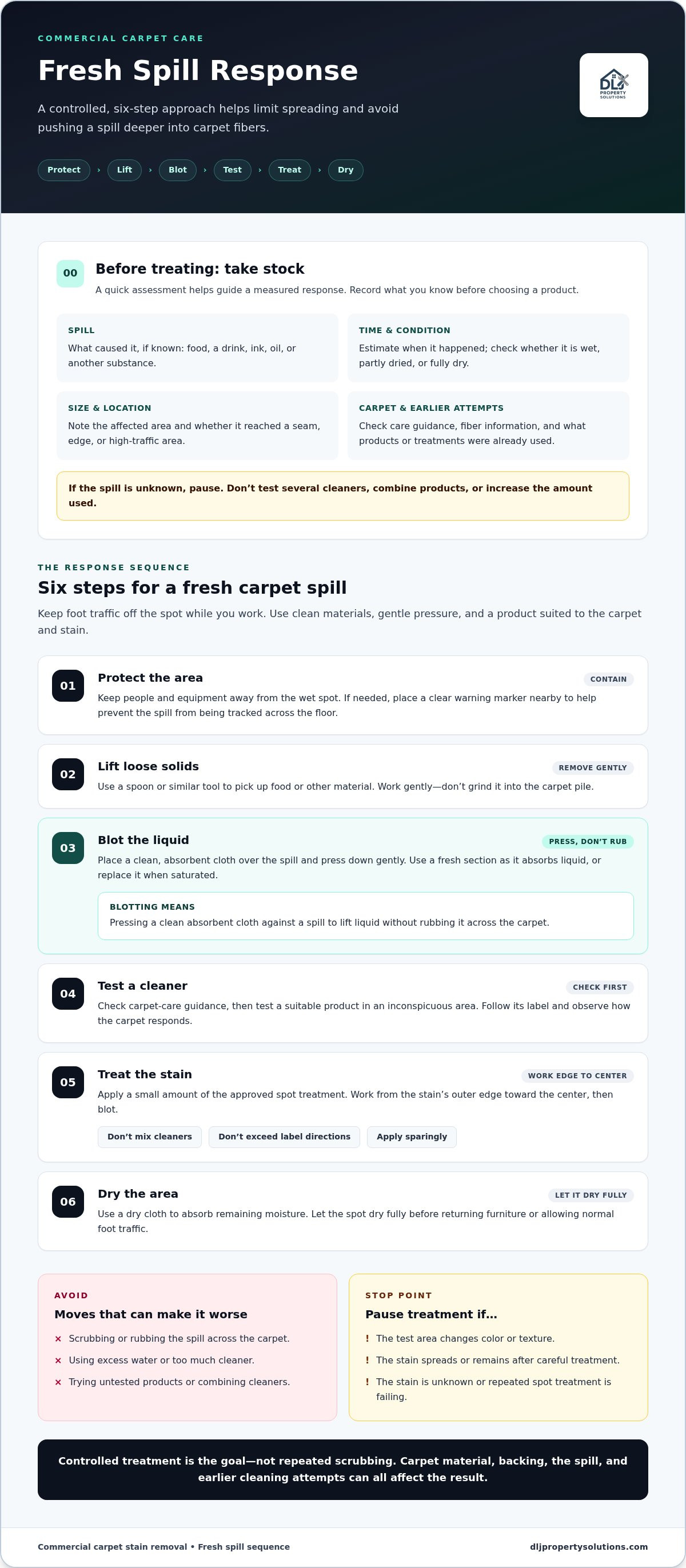
A fresh spill calls for a steady sequence, not a fast scrub. Keep foot traffic off the spot while you work. Use clean materials and stop if the carpet changes color or texture. These steps can help limit spreading, but the outcome depends on the spill and the carpet.
- Protect the area. Keep people and equipment away from the wet spot. If needed, place a clear warning marker nearby so nobody tracks the spill across the floor.
- Lift loose solids. Use a spoon or similar tool to pick up food or other material. Work gently and don’t grind it into the carpet pile.
- Blot the liquid. Place a clean, absorbent cloth over the spill and press down gently. Blotting means pressing a clean absorbent cloth against a spill to lift liquid without rubbing it across the carpet.
- Test a cleaner. Check carpet-care guidance, then test a suitable product in an inconspicuous area. Follow its label and observe how the carpet responds.
- Treat the stain. Apply a small amount of the approved spot treatment. Work from the stain’s outer edge toward the center, then blot. Don’t mix cleaners or apply more than the label directs.
- Dry the area. Use a dry cloth to absorb remaining moisture. Let the spot dry fully before returning furniture or allowing normal foot traffic.
Blot first and remove loose material carefully
Use a fresh section of cloth as it absorbs liquid, or replace the cloth when it becomes saturated. Gentle blotting lifts liquid without dragging it outward. Scrubbing can spread residue and disturb carpet fibers. Keep your pressure controlled and work inward from the edge so the wet area doesn’t grow.
Test and apply a suitable spot treatment
A product that works on one carpet may discolor or affect another. Use only a cleaner suited to the carpet and stain, and follow both the product directions and available carpet-care guidance. Apply it sparingly. Excess moisture can travel into the carpet backing and leave residue. The CRI Commercial Carpet Cleaning Standards offer broader cleaning guidance to consider alongside the carpet’s own care instructions.
Keep commercial carpet stain removal controlled. If the test area changes, the stain spreads, or the spot remains after careful treatment, stop rather than repeating the process with stronger products. For broader dirt, heavy stains, or repeated spot-treatment failures, commercial carpet washing can address the carpet beyond one small spill.
Which Stain-Removal Methods Work Best, and Which Can Backfire?
Choose a method based on the size of the problem and what the carpet can tolerate. Blotting is a first response. Spot treatment targets one mark. Commercial carpet washing addresses wider soil, heavy stains, and areas where repeated spot attempts haven’t worked. Each method has limits. Using a more intensive method on a small spill, or treating a widespread soil problem as a single spot, can waste effort and create new issues.
Blotting, spot treatment, and deep washing compared
Blotting lifts accessible liquid but does not clean the carpet by itself. Spot treatment applies a suitable cleaner to a limited area, so the result depends on the stain, fiber, backing, and product directions. Broader washing is the practical next step when stains are heavy or soil is spread across a business space. The IICRC Cleaning and Restoration Standards provide a reference for professional cleaning practices.
| Method | Appropriate use | Caution | Next step |
|---|---|---|---|
| Blotting | Fresh liquid spills | Won’t remove every residue | Assess the stain once liquid is lifted |
| Spot treatment | A localized mark suited to the product | Untested cleaner may affect color or fibers | Stop if the carpet changes or the stain persists |
| Commercial carpet washing | Heavy stains or accumulated soil | Requires an approach suited to the carpet | Use for broader cleaning needs |
Common mistakes that can worsen a carpet stain
Scrubbing feels active, but it can drive residue outward and disturb the carpet pile. That can leave a larger, rougher-looking area than the original spill. Use controlled pressure instead. Repeat a cleaner application only if its directions allow it. More product does not necessarily mean a better result.
Keep cleaning products separate. Mixing cleaners can produce unpredictable results and may harm carpet fibers or leave residue. Follow the label, and don’t layer a new treatment over an earlier product without knowing what was used. If previous cleaning attempts are unknown, pause rather than adding another chemical.
Too much water creates another problem. Moisture can travel below the visible stain, take longer to dry, and affect the carpet or backing. Use spot treatments sparingly, then absorb remaining moisture. If the area stays wet or the mark returns, stop repeated DIY attempts. Commercial carpet stain removal works best when the response matches the carpet and the scale of the problem. Choose the least intensive suitable method, then move to broader washing when spot treatment is no longer enough.
When Should You Stop DIY Commercial Carpet Stain Removal?
Stop when the stain or carpet responds in an unexpected way. An unknown spill, a mark that returns after drying, a persistent odor, or visible changes to the fibers are all reasons to pause. Repeating the same treatment may spread residue, add product buildup, or affect nearby carpet. More effort isn’t always safer.
Decision rule: treat a fresh, isolated spot cautiously. Stop DIY treatment when the stain returns, spreads, affects the carpet, or appears across multiple areas. Size matters, but so does location. A small mark in a busy entrance can disrupt daily use more than a larger spot in a rarely used room.
Before deciding what to do next, consider the full picture:
- Spill identity: If you can’t identify what caused the stain, avoid testing cleaners at random.
- Cleaning history: Note what products or methods have already been tried. Earlier treatments can leave residue or change how the stain responds.
- Area and spread: One contained mark differs from widespread discoloration or several affected areas.
- Business use: Consider foot traffic, access needs, and whether the affected space must remain open.
Signs a stain needs more than a spot treatment
A stain that remains visible after a cautious attempt, or returns once dry, may need a different level of cleaning. Persistent odor, multiple stains, or broad discoloration can point to a problem beyond one isolated spot. Stop immediately if the carpet’s color or texture changes during treatment. Don’t keep applying products to see if the change will reverse.
Repeated attempts can make the next treatment harder to assess. Each new product may add residue or affect a wider area, while rubbing can disturb surrounding fibers. Record what was spilled and what has already been tried. That history helps guide the next cleaning decision.
Plan cleaning around business traffic and access
Consider how people move through the area. A stain near an entrance, shared walkway, or work zone may need to be isolated while it’s treated and dries. Use a clear marker or barrier to keep foot traffic off the carpet. Follow product directions about use and drying, and don’t assume the area is ready until it is dry.
If the issue covers a wider area, involves heavy soil, or keeps returning despite careful spot treatment, commercial carpet washing may be the practical next step. DLJ Property Solutions LLC provides commercial carpet washing for business spaces in Orange County, targeting heavy stains, dirt, and wear. Learn about commercial carpet washing when spot treatment is no longer enough.
Commercial Carpet Washing in Orange County: The Next Step for Stubborn Stains
A single fresh spot may be manageable with careful treatment. A different approach makes sense when soil covers a wider area, heavy stains remain, or the same spots keep returning after repeated attempts. More spot cleaner won’t necessarily solve a carpet-wide problem. It can add residue and moisture without addressing surrounding dirt and wear.
Commercial carpet washing is the broader next step for business spaces. DLJ Property Solutions LLC provides commercial carpet washing in Orange County, California, addressing heavy stains, dirt, and wear in commercial spaces. This service suits broader cleaning needs, not just one isolated mark. Results depend on the stain, carpet construction, and previous treatments, and some stains may remain visible after cleaning.
What commercial carpet washing addresses
Commercial carpet washing provides deep cleaning tailored to commercial-grade carpets. It can address heavy stains and accumulated dirt across a larger area, rather than concentrating only on one spot. Carpet condition, stain type, and earlier cleaning attempts all shape the result. Set realistic expectations: washing can improve the carpet’s condition, but it can’t guarantee every stain will disappear or the carpet will look new.
Coordinate carpet care with property turnover
Carpet washing can fit into a business-space cleanout when accumulated soil or stubborn stains remain after contents are removed. It may also sit alongside post-cleanout punch-list repairs that help prepare the space for its next client. Treat these as related turnover tasks, not a reason to keep applying spot products to a stain that isn’t responding.
Before planning broader cleaning, gather a few useful details about the space and carpet. This gives the project a clearer starting point:
- Area affected: Identify whether the concern is limited to one room, a walkway, or several carpeted spaces.
- Carpet condition: Note visible dirt, heavy stains, and signs of wear.
- Treatment history: Share what products or cleaning methods have already been used, if known.
- Access needs: Describe how the space is used and any areas that need to remain accessible.
Commercial carpet stain removal is one part of maintaining a usable business space. If spot treatment has failed or the concern extends beyond a single stain, broader washing may be more practical. Share your Orange County project details with DLJ Property Solutions LLC to discuss commercial carpet washing for your space.
Set Up the Next Cleaning Step
A carpet problem doesn’t have to become a cycle of stronger products and repeated attempts. Use what you’ve learned to decide whether the space needs a focused response or broader care. For a stubborn or widespread issue, commercial carpet stain removal may be only one part of getting the floor ready for continued business use.
DLJ Property Solutions provides commercial carpet washing in Orange County, tailored to commercial-grade carpets and aimed at heavy stains, dirt, and wear. The right next step depends on the carpet’s condition and cleaning history. Share those details up front to give the project a clear starting point.
Share your commercial carpet cleaning project with DLJ Property Solutions to discuss the next step for your Orange County business space.
Frequently Asked Questions
How do you remove a fresh stain from commercial carpet?
Act promptly, but keep the response controlled. First identify the spill if possible and check the carpet’s care instructions before using a cleaner. Keep staff and visitors from walking through the area, since shoes can track residue beyond the original spot. If the spill is unidentified or the carpet’s fiber is unknown, avoid experimenting with products. Record what happened and what you’ve applied for whoever handles the next cleaning step.
Should you scrub or blot a commercial carpet stain?
Blot rather than scrub. Rubbing can spread residue, flatten or disturb the pile, and make the affected patch look larger. Use a clean cloth and gentle pressure, changing to a dry section as it picks up liquid. For a mark on textured carpet, press without twisting the cloth. If the stain doesn’t respond, don’t increase force. The carpet’s texture and color should remain unchanged during treatment.
Can vinegar or baking soda remove commercial carpet stains?
They may help with some household spills, but neither is a safe default for every commercial carpet. Vinegar can affect sensitive fibers or dyes, while baking soda can leave particles that are difficult to remove from dense pile. Don’t combine household ingredients with commercial cleaners. Check the carpet-care guidance and test any proposed treatment in a hidden area. If you can’t confirm it’s suitable, avoid applying it to a visible section.
How do you remove coffee stains from commercial carpet?
Treat coffee as a colored beverage stain, and don’t assume one cleaner suits every carpet. If the spill is fresh, carefully lift liquid before it spreads into nearby fibers. Check whether the coffee contained milk, sugar, or flavoring, since added ingredients can change the residue left behind. Follow the carpet’s care instructions and use only a compatible spot treatment. Older or repeatedly treated marks may need a broader cleaning approach.
What should you do if a carpet stain returns after cleaning?
Don’t keep layering cleaner onto it. A returning mark can mean residue remains in the carpet or that material below the visible surface is affecting the spot as it dries. Let the area dry, note what was used, and compare the stain’s size and appearance with its original condition. If it keeps reappearing, spreads, or develops an odor, stop spot treatment and consider broader carpet washing.
Can the wrong cleaner damage commercial carpet?
Yes. An unsuitable cleaner can change a carpet’s color or texture, leave residue, or affect fibers and backing. Damage isn’t always obvious while the carpet is wet, so don’t judge a test area immediately. Follow the product label and carpet-care guidance, and avoid mixing products or using a stronger concentration than directed. Stop if the test patch looks or feels different from the surrounding carpet.
When does a commercial carpet stain need professional washing?
Consider broader washing when the issue covers multiple areas, heavy soil is visible, or repeated spot treatment hasn’t resolved the problem. In Orange County, DLJ Property Solutions LLC provides commercial carpet washing for business spaces, addressing heavy stains, dirt, and wear. Cleaning results depend on the carpet, stain, and treatment history, so complete removal isn’t guaranteed. Share the affected area and previous cleaning details to help plan the next step.


