

Yes, garage cleanout services in Orange County can remove unwanted items without you first moving everything to the curb. The removal plan depends on the contents, access, and what you want to keep.
A packed garage can take more work than the visible pile suggests. You may need to separate keepers from items to donate or dispose of, and the volume, access, and sorting needs all affect the plan.
This guide explains how a garage cleanout works, what can stay inside until removal, and which details shape timing and truck space. You’ll get a practical picture of garage cleanout services before deciding what to keep and what to clear.
Key Takeaways
- Same-day or next-day scheduling may be possible when the schedule allows. Learn what to prepare so the job can move efficiently.
- Separate items you’re keeping from those to donate or dispose of, and make your decisions clear before removal begins.
- You don’t need to stage every item at the curb. The amount of contents and access to the garage shape the removal plan.
- Garage size alone doesn’t determine timing or truckloads. Contents, sorting needs, and layout also affect the work.
- For a property cleanout that also needs post-removal repairs, understand how those services can fit into the next step.
Do you offer same-day garage cleanout service in West LA and nearby neighborhoods?
For an Orange County garage, same-day scheduling with DLJ Property Solutions LLC depends on the available appointment window and the job’s scope. Share the address, preferred timing, garage contents, and access details when arranging service. A clear description helps set a practical schedule and avoids delays caused by discovering extra storage areas or bulky items after work begins.
Timing depends on more than the city or neighborhood. A clear route from the garage to the loading area helps crews from DLJ Property Solutions LLC move furniture, boxes, and loose clutter efficiently. Narrow side yards, stairs, locked gates, and items stacked behind storage can add handling steps. List bulky pieces, appliances, and heavy containers so the removal plan reflects the actual load. Professional garage cleanout services work best when the requested scope matches what’s inside.
Compare companies by matching each written estimate to your job. Check whether it covers sorting, lifting, loading, and removal, or only items placed outside. Compare how DLJ Property Solutions LLC handles furniture, appliances, and mixed clutter. A clear scope makes differences in service easier to assess than an appointment-time claim. Ask for the estimate to identify included areas, such as a workbench or storage alcove.
Review license information and insurance documents before work begins. Match the named business on those documents to the estimate and work order, and confirm that the paperwork describes the removal job at your property. These steps clarify who is responsible for the agreed scope and the crew entering the garage. Keep the written estimate with the job details for reference.
Garage cleanout services generally cover sorting, lifting, loading, and removing unwanted items from the space. Typical contents include furniture, cardboard, storage bins, old tools, sports equipment, and household debris. Scope matters: removing loose clutter differs from clearing packed shelves or hauling a heavy workbench. Treat deep cleaning and dust removal as separate tasks unless the written scope includes them.
DIY removal has practical risks. A loaded cabinet or refrigerator can shift while being moved, and awkward furniture can block the garage exit. Stored boxes can conceal pests, sharp debris, or leaking containers. Keep unknown chemicals, paint, or fuel separate from ordinary household items. Set questionable materials aside for identification before disposal, and keep children away from unstable stacks.
Deep cleaning starts after loose items and debris are gone. Sweep visible dust and dirt, then inspect corners, shelves, and the floor for residue or hidden clutter. A broom handles dry debris; a damp cloth works for dust on accessible surfaces. Pressure washing is for exterior cleaning, not a substitute for sorting or interior dust removal.
Before arranging garage cleanout services with DLJ Property Solutions LLC, prepare a short inventory. Mark items to keep, identify bulky pieces, and note access barriers such as a narrow driveway or locked gate. Share clear photos if the booking process allows them. Those details help define the removal sequence, truck access, and appointment window for the Orange County property.
Sorting belongings to keep, donate, or dispose
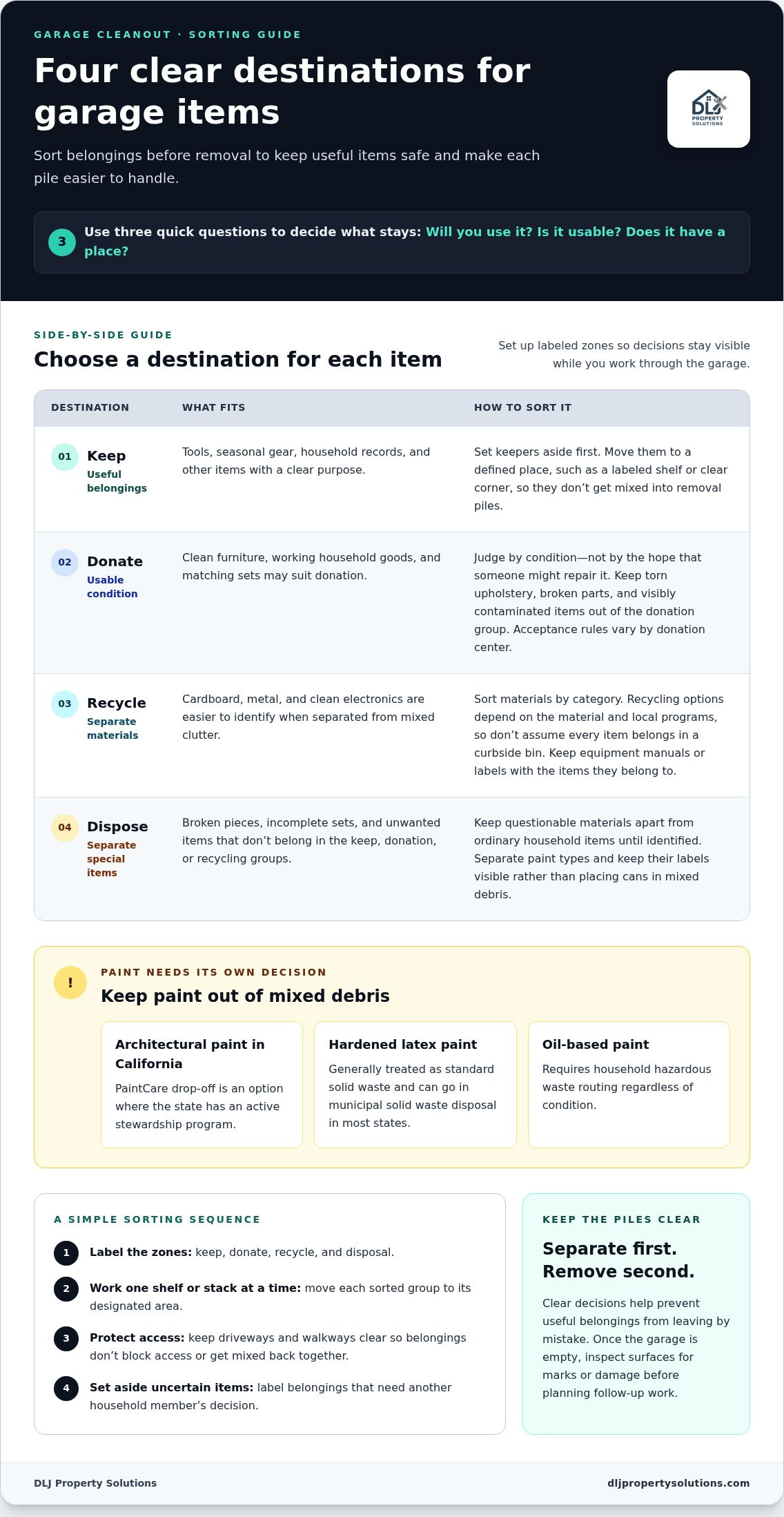
Use three clear groups: keep, donate, and dispose. Mark each area before sorting, so decisions stay visible as you work through the garage.
Sorting Items to Keep or Remove
Set aside keepers first, including tools, seasonal gear, and household records. Move them to a defined place, such as a labeled shelf or a clear corner. Then assess unwanted items by condition and usefulness. An intact chair or working lamp may suit donation; broken pieces and incomplete sets need a separate decision. Don’t let one uncertain item stop progress across the rest of the garage.
Use a practical test for each object: will you use it, is it in usable condition, and does it have a place? Keep items with a clear purpose. Set aside belongings that need another household member’s decision, and label that group. In an Orange County property, keeping keepers separate from removal piles helps prevent useful items from leaving by mistake.
Donation and Recycling Decisions
Judge donations by condition, not by the hope that someone might repair them. Group clean furniture, working household goods, and matching sets. Keep torn upholstery, broken parts, and visibly contaminated items out of that group. Donation centers set their own acceptance rules, so sort by category and keep manuals or labels with the equipment they belong to.
Separate materials before disposal. Cardboard, metal, and clean electronics are easier to identify when they aren’t buried in mixed clutter. Recycling options depend on material and local programs, so don’t assume every item belongs in a curbside bin. In California, architectural paint can go to a PaintCare drop-off where the state has an active stewardship program.
Sort paint separately from ordinary household contents. Hardened or solidified latex paint is generally treated as standard solid waste and can go in municipal solid waste disposal in most states. Oil-based paint requires household hazardous waste routing regardless of condition. Keep paint types apart and labels visible rather than placing cans in a mixed debris pile.
Set up labeled zones for keep, donate, recycle, and disposal. Work through one shelf or stack at a time, then move each sorted group to its designated area. In Orange County, keep the driveway and walkways clear so sorted belongings don’t block access or get mixed back together. Once the garage is empty, inspect surfaces for marks or damage before planning any follow-up work.
If the property needs repairs after trash removal, post-cleanout property repairs can address that next stage.
Can you do West Los Angeles garage cleanouts without me moving anything to the curb?
Yes. A garage cleanout can be planned for removal from inside the garage, so you don’t have to move every item to the curb first. A standard two-car garage in the Los Angeles metro typically takes 1-2 truckloads. A three-car garage or workshop with substantial accumulated contents typically takes 2-4 truckloads.
Truck-space pricing ties the estimate to how much room the load occupies. A few bulky pieces may take more space than tightly packed boxes, even when the item count is low. An onsite walkthrough can show the crew what’s being removed, what stays, and whether shelves or work areas are included. Clear details reduce misunderstandings about the scope.
The price depends on the job and is provided after a quote request. Key factors include the volume and type of items, access to the garage, and sorting or handling needs. Junk removal estimates may use a portion of truck capacity rather than a count of individual objects. Keep the estimate focused on the actual load, including furniture, appliances, loose debris, and items hidden behind stored belongings.
Online booking can help organize the request, but the information entered matters. Describe the garage size, the main categories of contents, and any large objects. Include a photo of crowded corners or a packed workbench if the form allows it. An upfront estimate should explain the removal scope and how truck space affects the quoted amount, rather than leaving key details unclear.
Prepare the garage by identifying what stays and moving valuables, paperwork, and small keepsakes to a separate, secure area. Mark items for removal, clear a path to the exit, and mention narrow driveways, gates, or stairs during booking. You don’t need to carry unwanted contents outside; access notes help plan the route from garage to truck.
Before accepting an estimate, compare its details against the job. Check whether it describes removal from inside the garage, loading, and the items included. Ask for the estimate to reflect additions such as a second storage area or bulky equipment. A written scope makes it easier to compare truck-space estimates with another format, such as a set charge per item or load size.
Keep disposal items that need special handling separate from ordinary household contents. Paint, fuel, and unknown liquids should be identified before removal rather than mixed into boxes. If the garage includes items you’re keeping, label that group clearly. This keeps the loading sequence direct and helps prevent a wanted item from being mistaken for junk.
For a useful estimate, share the full picture: garage size, contents, access, and what stays. Those details support a more accurate booking plan and show whether the expected truck space matches the removal work.
Cleanout duration and truckloads
Most garage cleanouts in the Los Angeles metro take a half-day to a full day. A standard two-car garage typically takes 3-5 hours to clear. A three-car garage or workshop with substantial accumulated contents can take 6-8 hours or be split across two days. These ranges give you a planning baseline, not a promise that every garage follows the same schedule.
Truckloads depend on volume and how items fit together. A standard two-car garage typically requires 1-2 truckloads. A three-car garage or workshop with substantial contents typically needs 2-4 truckloads. A stack of flattened cardboard uses space differently from a bulky sofa, shelving unit, or workbench. Item count alone won’t show the full load.
Build a useful estimate from three details: the garage layout, the contents, and the access route. Note packed shelves, large furniture, loose debris, and items stored behind other belongings. Point out stairs, a narrow exit, or a long path to the loading area. Each can affect how quickly the crew can move and load items.
Sorting also affects duration. If tools, household records, and seasonal items need careful separation, allow for that work in the schedule. A garage with clearly marked keepers and removal items has fewer decision pauses. A workshop with mixed boxes and equipment can take longer because items must be identified before lifting or loading.
Use this sequence to prepare a realistic time window:
- List the largest items, such as a refrigerator, cabinet, or couch.
- Identify shelves, corners, and storage zones that need clearing.
- Separate belongings staying in the garage from items for removal.
- Describe access from the garage to the truck, including gates or stairs.
That inventory gives the estimate more useful detail than garage size alone. It also helps distinguish a mostly open two-car space from one packed floor to ceiling. Keep access paths clear where possible, and flag fragile or awkward items before lifting begins. The loading order can then account for pieces that need careful handling.
Truckload estimates and time estimates answer different questions. Truck space describes how much material leaves; duration describes the sorting, lifting, carrying, and loading work. A few large items may fill space quickly, while many small objects can require more handling. Compare both estimates against the actual contents, not just the garage label.
For a multi-stage cleanout, plan around the work that must happen first. Removing stored boxes may expose more items or open access to a workbench. If the garage is part of a larger property cleanout, list each area separately. That keeps the scope clear and helps organize the sequence without treating the garage as an isolated pile.
Garage cleanout service
A garage cleanout is a sequence of decisions and physical work, not simply a truck pickup. In Los Angeles, garages may hold belongings accumulated for 5, 10, or 20 years. A practical service starts by defining what stays, what leaves, and which areas need clearing. That scope keeps the work organized from the first shelf to the final load.
Start with a walkthrough of the garage. Identify storage zones, such as wall shelving, overhead racks, a workbench, and the floor beneath boxes. Point out items that must remain, including tools, records, and seasonal equipment. Then separate the removal group from keepers. Clear instructions matter most where similar boxes or containers sit together.
Next, sort the items leaving by type and handling needs. A sofa, a stack of cardboard, and loose hardware require different lifting and loading approaches. Keep paint, fuel, and unidentified liquids apart from ordinary household debris. Label containers clearly and set aside items requiring special disposal routing. This prevents the crew from treating every object as interchangeable junk.
Removal work also depends on the garage’s access. A clear path to the exit lets bulky items move without repeatedly shifting stored belongings. Note narrow doors, steps, gates, or a long route to the loading area. If the garage connects to another storage space, define whether that area belongs in the cleanout. A precise boundary helps prevent missed sections or unwanted removals.
Once the unwanted contents are gone, inspect what remains. Check shelves, corners, and the floor for debris hidden behind stored items. A cleared garage makes it easier to see damaged surfaces, loose hardware, or areas needing a separate cleaning task. Pressure washing is an exterior add-on; it doesn’t replace interior sorting or debris removal.
For a property turnover, the garage may be one part of a larger cleanout. List each space separately, such as the garage, a storage room, and an exterior area. After trash removal, note any punch-list repairs needed before the next occupant. Separating removal from repair work makes the next steps clearer and keeps the property’s remaining tasks organized.
Before scheduling, prepare a concise scope: what stays, what goes, access limits, and any materials requiring separate handling. Include photographs of packed shelves or bulky equipment when available. Those details help describe the job accurately and set a clear sequence for removal. Share your cleanout details to take the next step.
DLJ Property Solutions: Property cleanouts
DLJ Property Solutions LLC handles property cleanouts when a garage is part of a larger residential or commercial clearout. The work removes unwanted contents and helps leave the space ready for its next use. After trash removal, punch-list repairs can address practical issues before the next client. Pressure washing is available as an add-on for exterior surfaces, while commercial carpet washing serves properties with carpeted areas that need cleaning.
Turn to this service when the job includes more than sorting a few items, or when removal is one step in preparing a property for its next occupant. Share the spaces involved, what needs to go, and any repairs needed after removal. For a straightforward next step, contact DLJ Property Solutions LLC with your cleanout details.
Set the Next Property Task in Motion
A cleared garage can be the start of a larger property reset. Decide what the space needs next: a cleanout, attention to carpeted areas, exterior washing, or repairs after trash removal. Keeping those tasks in one clear scope helps move the property from removing unwanted contents to preparing for its next use.
DLJ Property Solutions handles property cleanouts, commercial carpet washing, and pressure washing as an add-on for exterior surfaces. The company also performs repairs after trash removal to help prepare properties for the next client. These services fit when a garage clearout connects to other work across a residential or commercial property.
Before reaching out, note which areas need attention and what outcome you need from the cleanout. That gives the conversation a practical starting point. If you’re ready to plan the next step for your garage cleanout services, contact DLJ Property Solutions with the property details. A clear scope puts the work in motion.
Frequently Asked Questions
Do you remove bulky garage items like old appliances, shelving, or workout equipment?
Bulky items can be included in a property cleanout when they’re unwanted contents. In an Orange County garage, examples might include a discarded treadmill, an empty storage cabinet, or a broken appliance. Identify which items should stay and which should go before removal begins. For built-in shelving or equipment attached to walls, describe the installation clearly so the cleanout scope accounts for the extra handling.
Can you haul away renovation debris from a garage cleanout in West LA?
Property cleanouts cover unwanted items, trash, and debris, including debris present in a garage. That’s different from renovation work: a cleanout does not include remodeling or construction. In West LA or Orange County, separate loose debris from materials still attached to walls, floors, or fixtures. This distinction helps define whether the task is clearing contents or performing building work.
What Do You Gain From Professional Hauling Support?
Professional hauling support takes the removal work off your hands and helps clear a garage for its next use. In an Orange County property, that can make it easier to prepare a space for inspection, turnover, or follow-up repairs. You can focus on identifying what stays and sharing access details, rather than arranging separate removal for each unwanted item.
What about old paint cans that have hardened or dried out?
Hardened or solidified latex paint is generally treated as standard solid waste and can go in municipal solid waste disposal in most states. In California, architectural paint can go to a PaintCare drop-off where the state has an active stewardship program. Oil-based paint requires household hazardous waste routing regardless of condition. Keep paint types separate and labels visible during sorting.
How much do garage cleanout services cost in the United States?
The price depends on the job and is provided after a quote request. For an Orange County garage, the main cost factors include the amount and type of contents, access from the garage to the loading area, and the sorting or handling involved. A clear inventory and photos of bulky items can help describe the job accurately instead of relying on a rough guess.
How do garage cleanout companies calculate pricing, by volume, weight, or hourly rate?
Pricing methods can vary, so compare the estimate’s stated basis and scope rather than assuming every company uses the same formula. Volume reflects truck space; weight may matter for dense debris; hourly pricing focuses on labor time. In Orange County, ask that the estimate distinguish removal from extra sorting or handling, so you can see what work the quoted amount covers.
What items can garage cleanout services take, and what items are prohibited?
Property cleanouts address unwanted items, trash, and debris from residential and commercial spaces. Contents can include household goods, discarded furniture, boxes, and loose garage debris. Some materials need separate disposal routing, so don’t mix unidentified liquids, paint, or fuel with ordinary items. In Orange County, make a distinct pile for anything requiring special handling and keep its container or label identifiable.
Do garage cleanout services donate, recycle, or dispose of usable items?
Separate usable items from damaged or unwanted debris before removal. In an Orange County garage, group clean furniture or working household goods together and keep broken pieces apart. Donation and recycling options depend on the item’s condition and material, so don’t assume every object will be accepted. Mark anything you want to retain clearly to prevent it from joining the removal pile.


